
DATA AND STATISTICS
Use the state selector tool below to see a comparison between the FLS AEWR and OEWS wage rates for crop farmworkers in each state for 2021-2025.
OEWS by State
What do OEWS wages for farmworkers look like in your state? Take a glimpse at what OEWS wages mean for your farm or ranch by using the data finder below.
2025 IFR: AEWR Methodology for the Temporary Employment of H-2A Nonimmigrants in Non-Range Occupations in the United States
On October 2, 2025, the Department of Labor Published an Interim Final Rule, Adverse Effect Wage Rate Methodology for the Temporary Employment of H-2A Nonimmigrants in Non-Range Occupations in the United States, which impacts wages for agricultural employers nationwide.
A copy of the rule can be accessed here.
The Statewide Hourly AEWRs and definitions for Skill Level I, Skill Level II, and compensation adjustment can be viewed below:
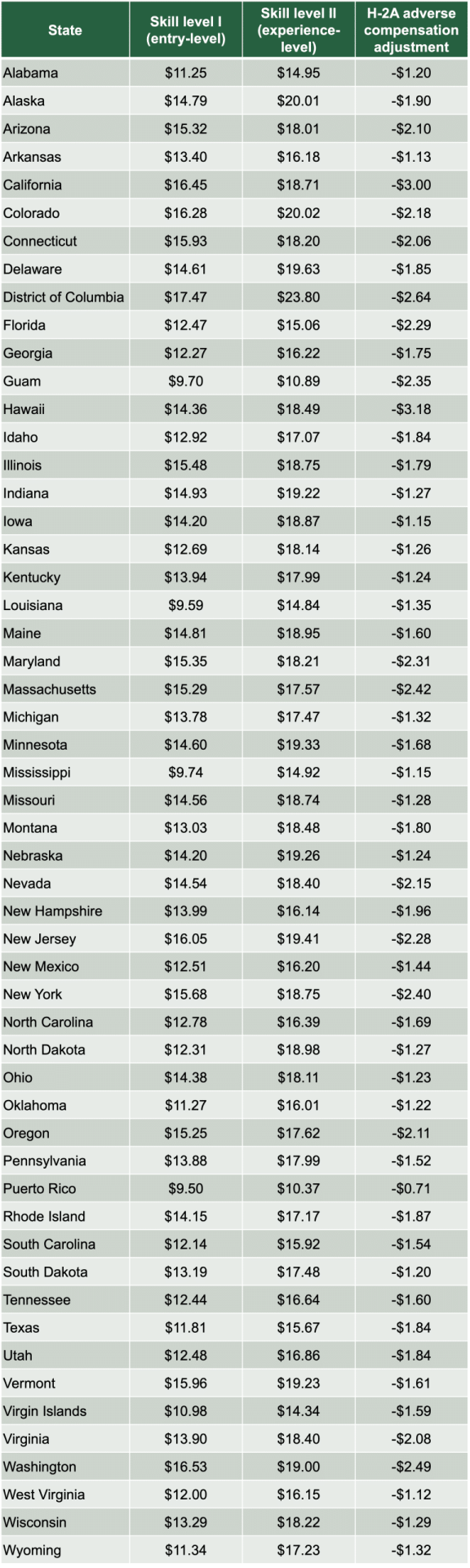
Downward Compensation Adjustment: The last column in the table lists the statewide downward compensation adjustments to the applicable AEWRs that can only be applied to H–2A workers who are provided with housing at no cost. For example, if employers are seeking to employ H-2A workers in Alabama for jobs in any of the five SOC codes encompassed by the “field and livestock workers (combined)” category, their job orders would specify in the job order ( i.e., Field A.8b of the Form ETA-790A) a wage offer to U.S. workers no less than $11.25 per hour where the duties and qualifications are commensurate with a Skill Level I position. For any H-2A worker(s) employed under the associated temporary agricultural labor certifications, employers would specify in Field A.8e or Addendum A of the job order wage offers to H-2A workers no less than $10.05 per hour ($11.25 per hour for Skill Level I minus $1.20 per hour adjustment).
Skill Level I (Entry-Level): A Skill Level I AEWR is associated with job offers containing qualifications commensurate with entry-level positions where workers need no formal education or specialized training credentials. In addition, employers typically require no or very little work- related experience under the Occupational Information Network (O*NET)116 system (e.g., up to 2 months of related work experience cultivating diversified vegetable crops) or, alternatively, may require a short demonstration (e.g., several weeks of on- the-job training) on how to perform the work by a more experienced employee, lasting anywhere from a few days to a few weeks. Employers seeking employees for this level of position require them to follow instructions from a supervisor or team leader on the employer’s agricultural methods and practices, use common equipment and tools to successfully perform the work, and help others as part of a work crew. Work performed by these employees is closely monitored, tracked, and assessed for quality, accuracy, and production results. In accordance with new paragraph (b)(2)(i), a Skill Level I AEWR will be computed as the average hourly gross wage paid to the lower one-third of all workers in the five SOC codes comprising the field and livestock workers (combined) category or, for occupations outside of that category, the average hourly gross wage paid to the lower one-third of all workers in the specific SOC code assigned to the employer’s job opportunity. A Skill- Level I AEWR is computed at the equivalent of the 17th percentile of the occupational wage distribution, which is similar to the skill-based prevailing wages for other nonimmigrant and immigrant visa programs administered by the Department.
Skill Level II (Experience-Level): A Skill Level II AEWR is associated with job offers containing qualifications commensurate with experience-level or qualified employees who possess, either through education, training, or experience, demonstrated skills or knowledge to perform the work covering the SOC code(s). Depending on the occupational classification, these positions may normally require some formal education or training credentials or certificates. In addition, employers typically require work-related experience at a level that is normal for the occupation under the O*NET system (e.g., 3 months of related work experience harvesting apples) and generally do not require a short demonstration on how to perform the work by a more experienced employee. Employers who hire employees into this level of position may also expect workers to perform moderately complex tasks (e.g., harvesting ‘‘first pick’’ apples for firmness, color, and placement on the tree) and follow instructions from a supervisor or team leader on the employer’s agricultural methods and practices, use common equipment and tools to successfully perform the work, and help others as part of a work crew. Work performed by these employees is not as closely monitored as employees in Skill Level I, but production may still require some level of tracking and assessment of quality when immediate delivery is to market. In accordance with new paragraph (b)(2)(ii), a Skill Level II AEWR will be computed as average hourly gross wage paid to all workers in the five SOC codes comprising the field and livestock workers (combined) category or, for occupations outside of that category, the average hourly gross wage paid to all workers in the specific SOC code assigned to the employer’s job opportunity. A Skill-Level II AEWR is computed at the equivalent of the 50th percentile of the occupational wage distribution, which is similar to the skill-based prevailing wages for other nonimmigrant and immigrant visa programs administered by the Department.
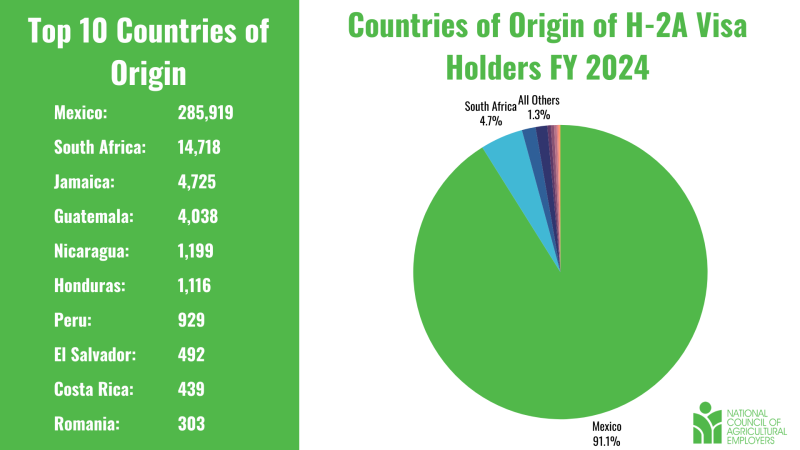
H-2A Program Statistics
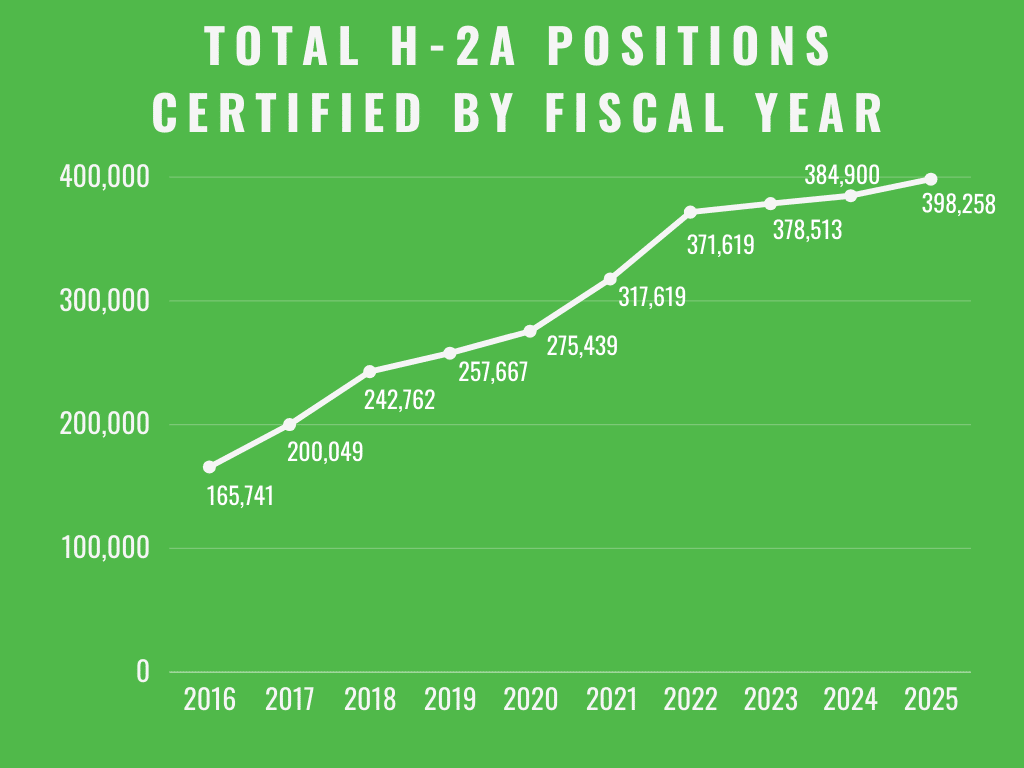
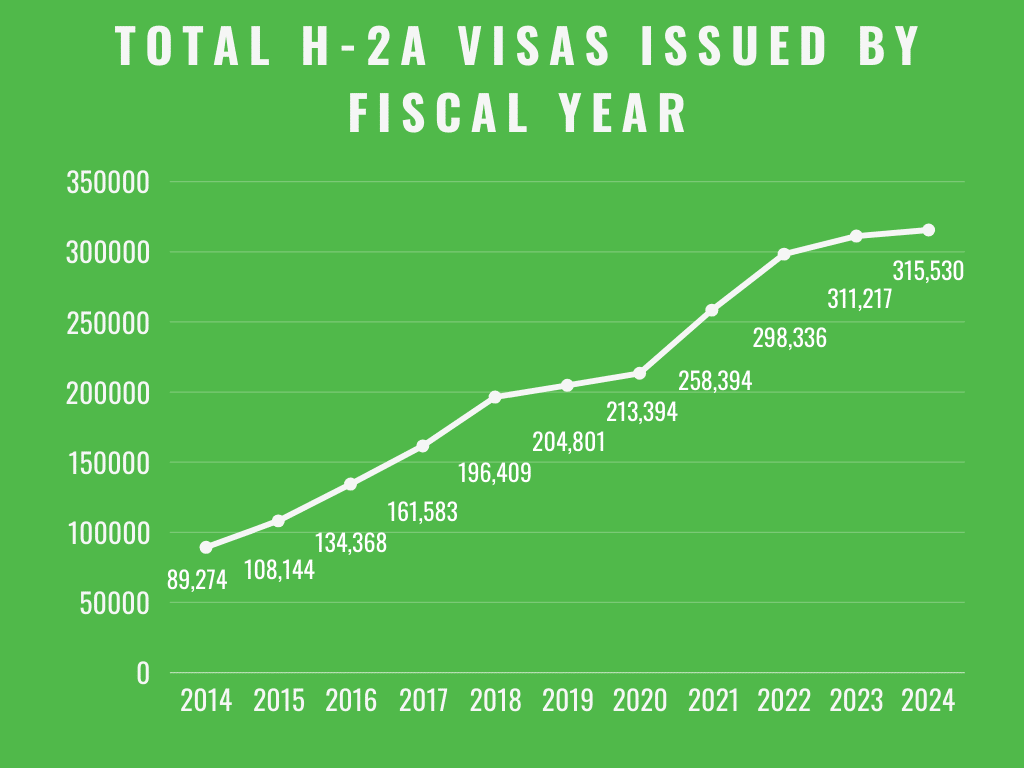
Data Source: Department of State’s Report of the Visa Office
Adverse Effect Wage Rate
Under the code of federal regulations governing the H-2A temporary agricultural worker program, the adverse effect wage rate (AEWR) is the minimum wage rate that employers must offer and pay to U.S. and alien workers by agricultural employers.
The Department of Labor publishes the AEWR annually for field and livestock workers (combined) in the States or regions based on data from the U.S. Department of Agriculture’s (USDA) quarterly wage survey.
Farm Labor Methodology and Quality Measures
This National Agricultural Statistics Service (NASS) document reviews the methodology and quality measures of their Agricultural Farm Labor Surveys.
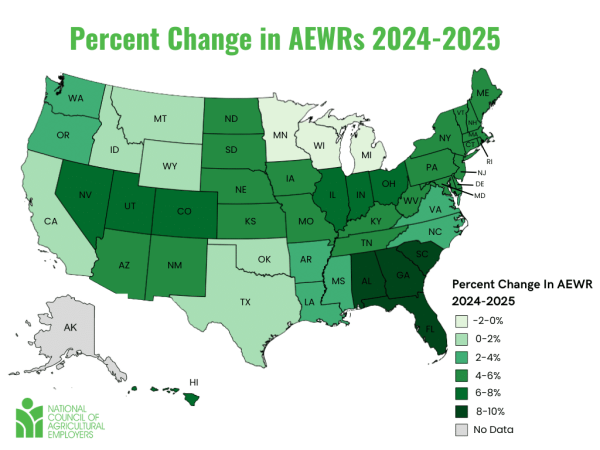
Data Source: USDA NASS Annual Farm Labor Survey Report
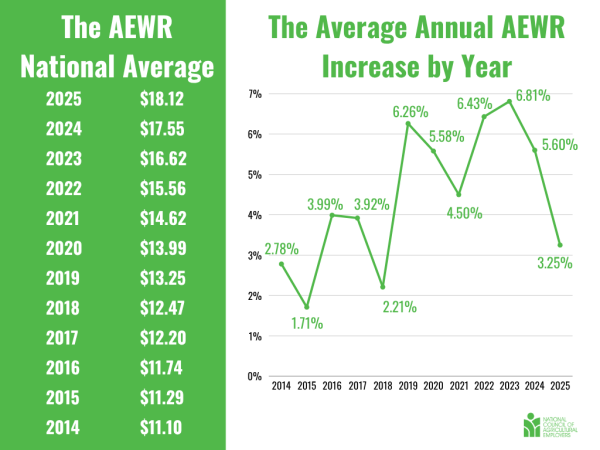
Data Source: USDA NASS Annual Farm Labor Survey Report
Office of Foreign Labor Certification Statistics
The Department of Labor’s Office of Foreign Labor Certification publishes quarterly select statistics, yearly select statistics, and other performance data for the H-2A temporary agricultural worker program.
H-2A Selected Statistics FY2026 Q1
H-2A Application Process

AEWR AND OEWS COMPARISON
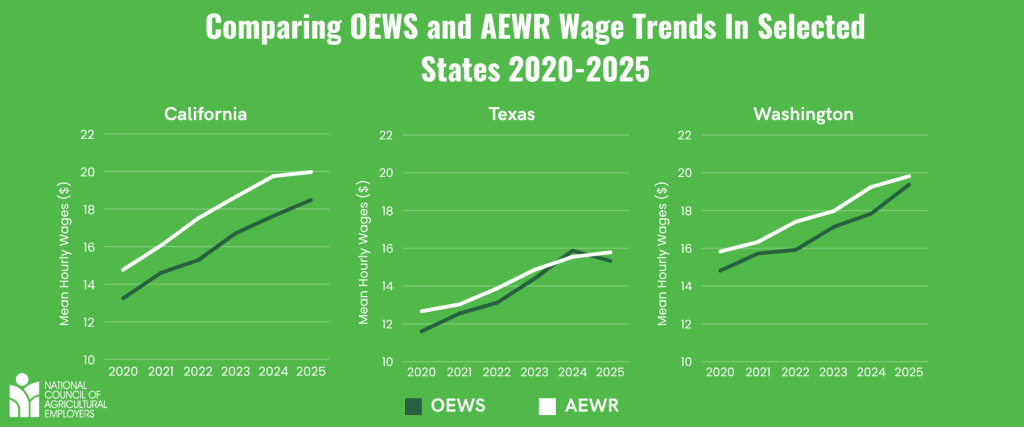

Current regulations mandate that H-2A employers must pay the highest of five wage rates, usually the Adverse Effect Wage Rate (AEWR) from the Farm Labor Survey (FLS). For job categories outside the traditional “Big Six” farm jobs, the Occupational Employment and Wage Statistics (OEWS) from the Bureau of Labor Statistics (BLS) apply. A major argument against the use of the AEWR is that it outpaces the rate of inflation.
Under current regulations, should the USDA stops publishing the FLS, the BLS OEWS rates will be used instead. One of the issues between the two data sets is the massive difference in the sample sizes used for the OEWS and AEWR, with the FLS having a smaller sample, leading to higher wage variability and significant annual changes in the AEWR.
Research shows a correlation between states with more hired agricultural workers and a higher AEWR that employers are required to pay. If this were switched to the OEWS data, employers in these states will suddenly be required to pay a lower wage to their H-2A workers. The differences between the AEWR and OEWS are important and vital to the future wages that H-2A employers will be required to pay.
Mechanization Trends in Agriculture
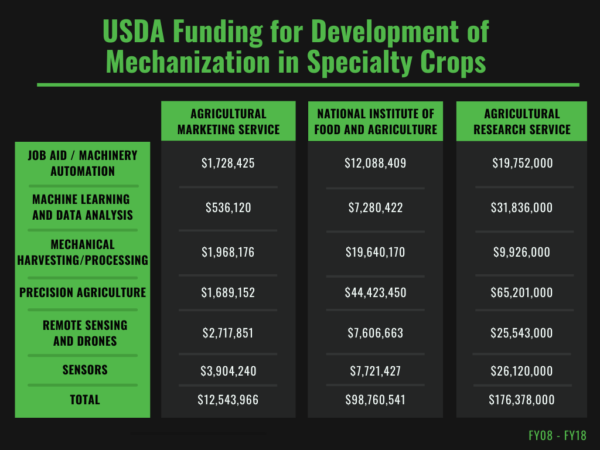
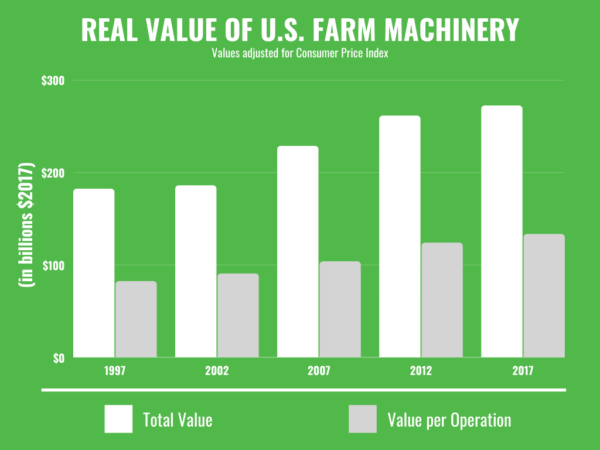
Data Source: U.S. Department of Agriculture’s Report to Congress
United States Department of Agriculture Efforts to Promote New Technology
The USDA has six programs in its Agricultural Marketing Service (AMS), National Institute of Food and Agriculture (NIFA), and Agricultural Research Services (ARS) agencies that accelerate the development and use of automation or mechanization in the production and processing of U.S. specialty crops.
AMS, NIFA, and ARS funded more than $287 million towards 213 projects between fiscal years 2008 and 2018.
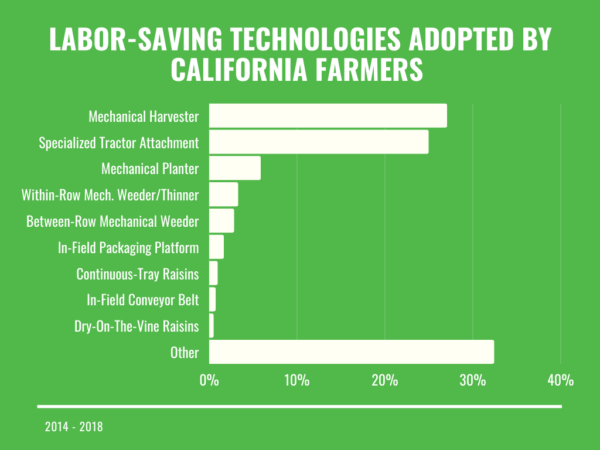
Respondents were asked, “Which labor-saving technology reduced your labor needs the most for the production of your main crop in your main county?”
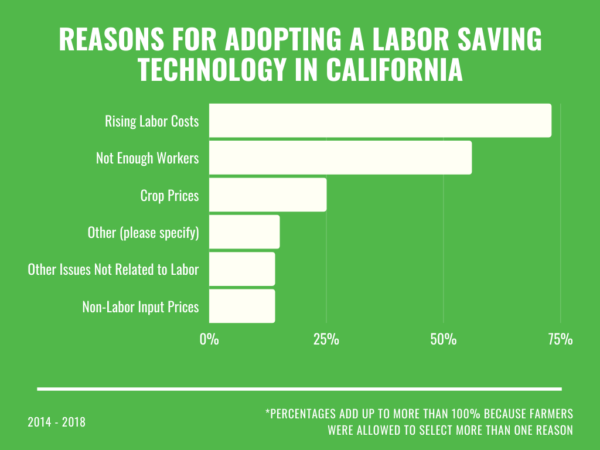
Respondents were asked, “What made you decide to use the [technology selected above] to produce [your main crop] in [your main] county that first year? (please select all that apply)”
Land Border Proof of Vaccination Mandate
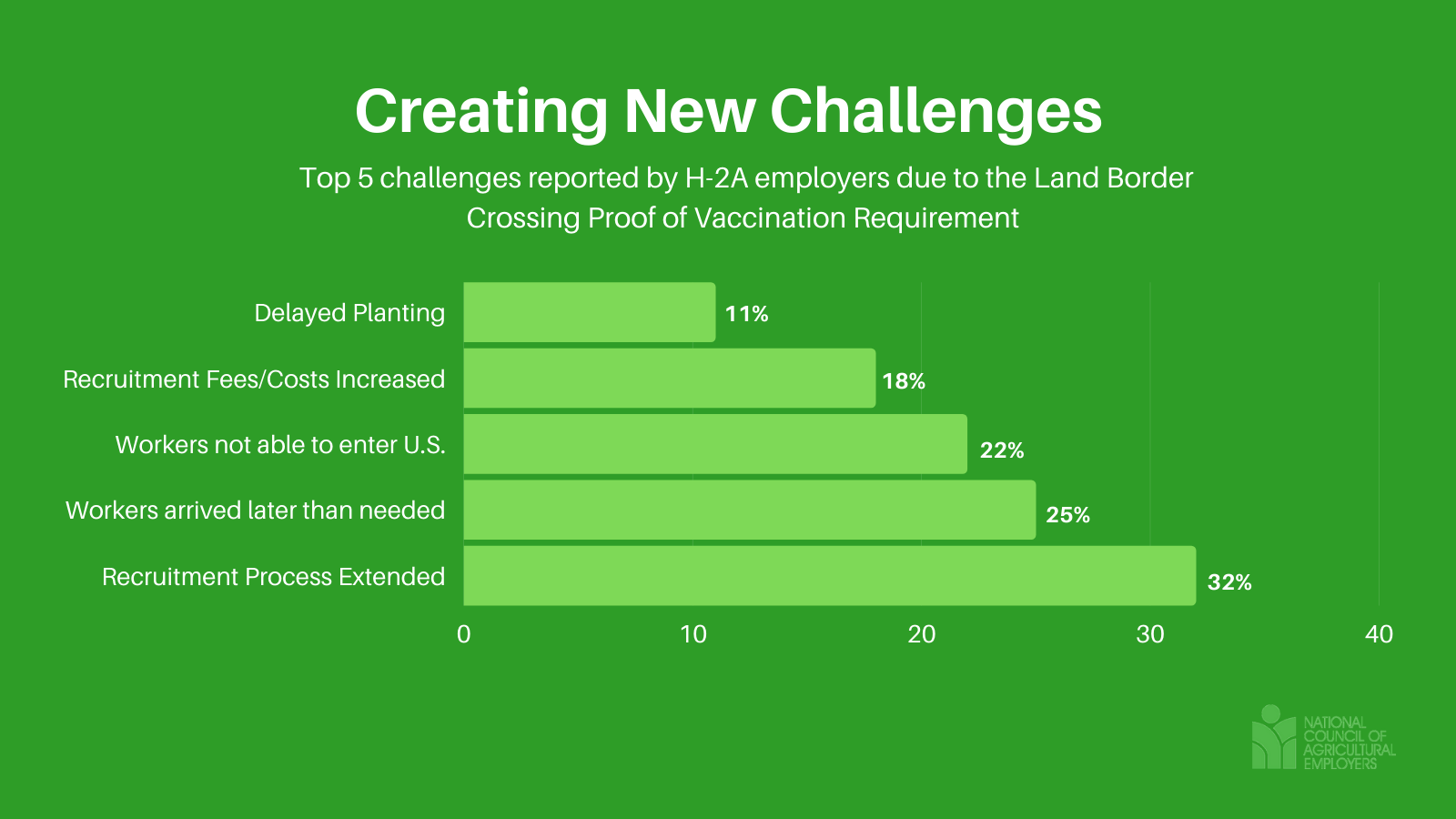
Respondents were asked, “Have you experienced any of the following negative situations because of the vaccination requirement?”
Impacts of Land Border Crossing Proof of Vaccination Mandate on Agricultural Employers
On January 22, 2022, the Biden administration implemented a mandate requiring noncitizen nonimmigrants crossing into the U.S. through land ports of entry to show proof of full vaccination against COVID-19 with a WHO/CDC approved vaccine. NCAE became aware of the possibility of this mandate in November 2020 and the challenges it would create for employers of H-2A workers. NCAE has tried repeatedly since becoming aware of this requirement to explain the impact of the regulation on the H-2A community and domestic food security to the Biden Administration.
In early April, NCAE partnered with the National Center for Farmworker Health (NCFH) to conduct a survey assessing the consequences of this rule on H-2A employers. Survey respondents were asked about their experiences and the impacts it has had and is expected to have on their ability to recruit and transport workers.
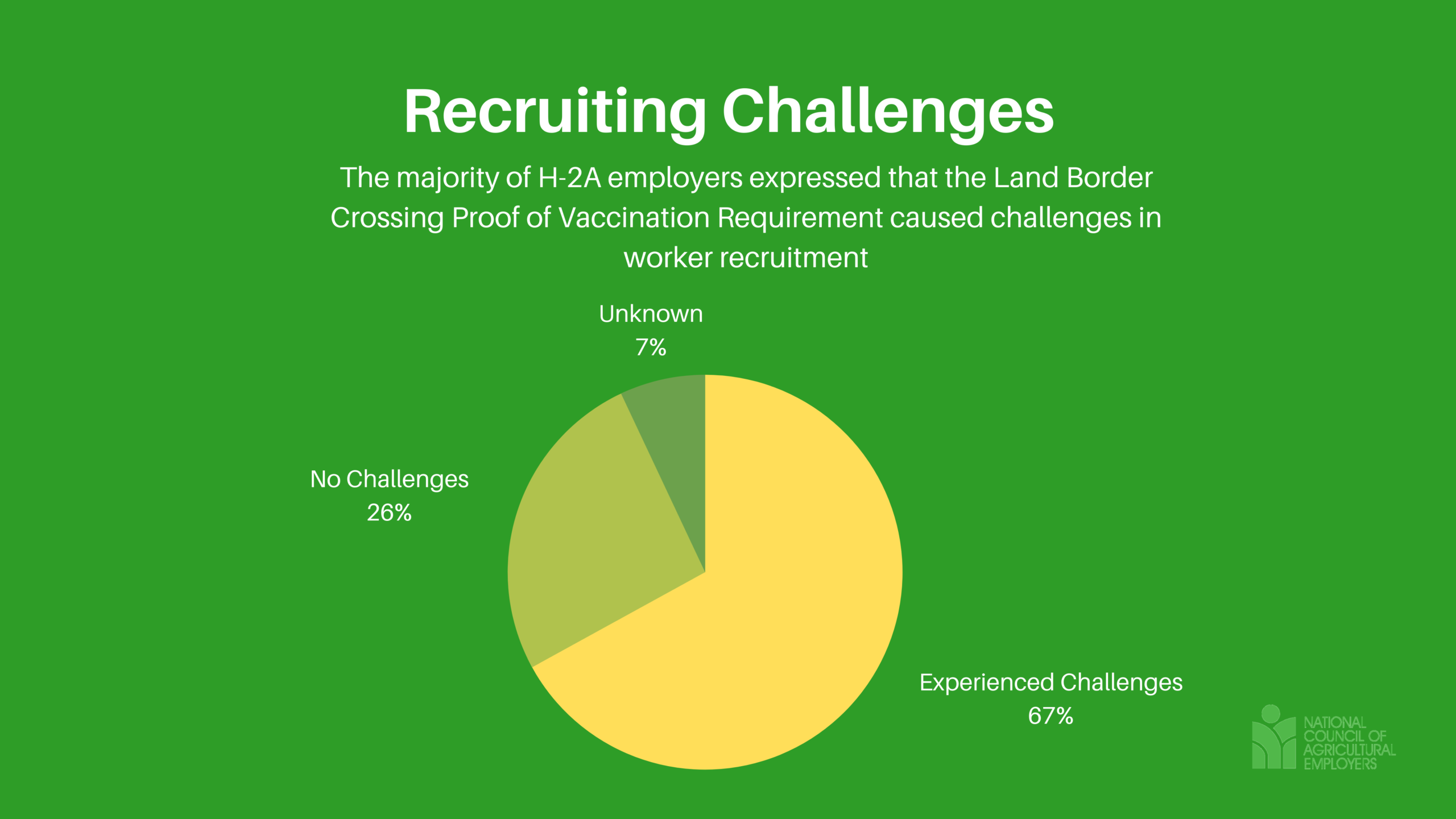
Respondents answered the question, “Has this requirement created any challenges for your enterprise in recruiting properly vaccinated H-2A workers?”
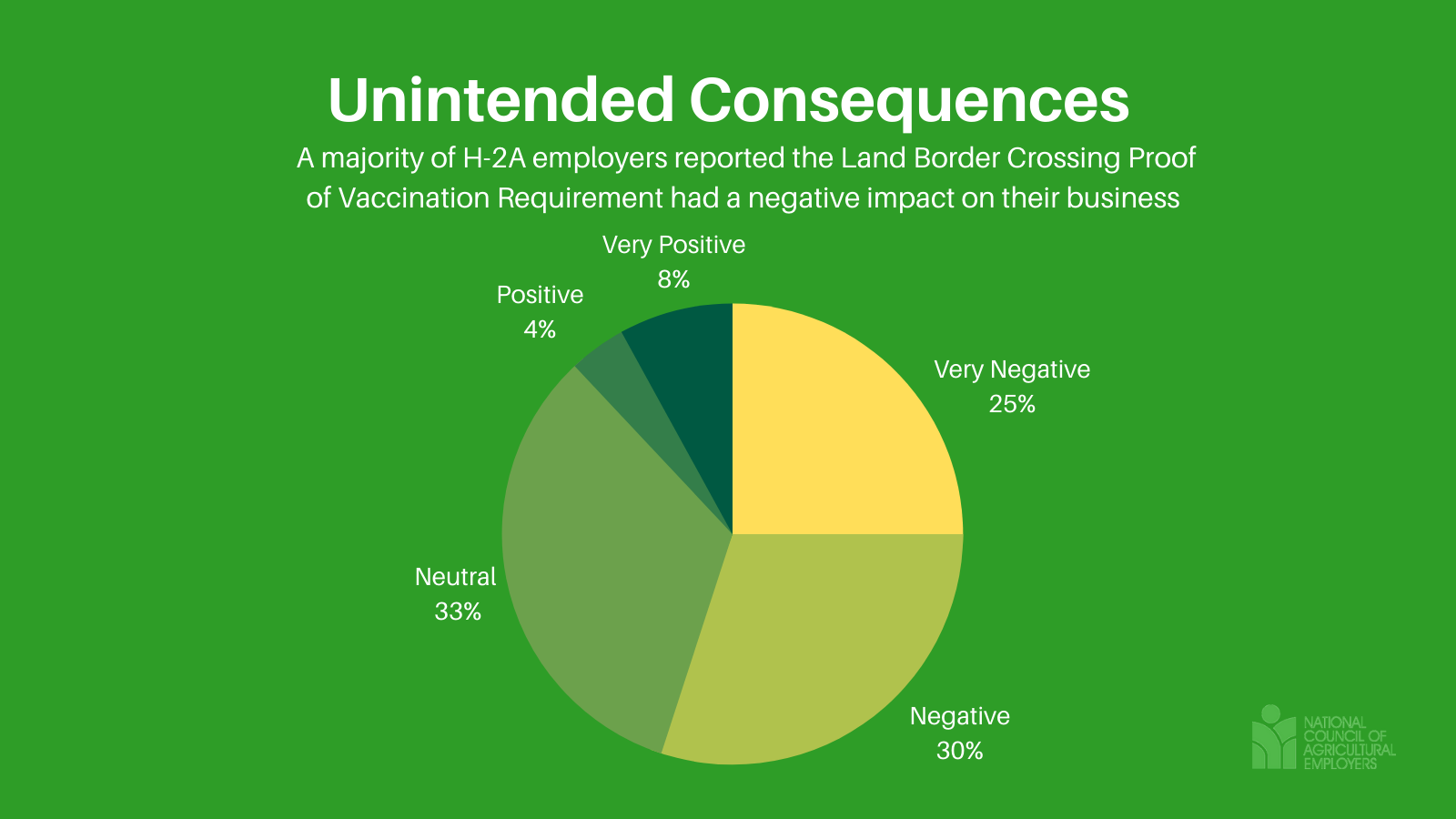
Respondents, who indicated they were aware of the vaccine mandate, were asked, “how would you describe the effect of this requirement on your business?”