

NCAE Applauds Introduction of Bipartisan Securing Agriculture’s Workforce Act (SAWA) by Chairman Glenn “GT” Thompson

The National Council of Agricultural Employers (NCAE) strongly supports the introduction of the Securing Agriculture’s Workforce Act (SAWA) of 2026, a vital piece of bipartisan legislation championed by House Agriculture Committee Chairman Glenn “GT” Thompson (R-PA). If passed, SAWA would be the first major legislative effort in 40 years to comprehensively modernize the outdated H-2A Temporary Agricultural Worker Program, providing long-overdue stability to America’s agricultural supply chain and safeguarding national food security.

“For decades, American farmers of all kinds have battled a broken, bureaucratic system just to secure the workforce needed to feed our nation, and the Securing Agriculture’s Workforce Act finally seeks to provide the reform Farmers, Consumers, and our Economy needs,” said John Hollay, President & CEO of the National Council of Agricultural Employers. “This bipartisan bill addresses head-on the exact challenges our organization and agricultural employers nationwide have focused on for years: expanding access for year-round sectors, implementing predictable cost controls, and streamlining the fractured program administration. We are incredibly grateful to Chairman Thompson for his visionary leadership and steadfast commitment to protecting American agriculture.”

The H-2A program, which has not seen statutory updates since its inception in 1986, has struggled to keep pace with modern farming realities. Despite skyrocketing demand—growing from fewer than 100,000 certified positions in 2013 to nearly 400,000 in 2025 due to a persistent lack of domestic labor—the program has remained plagued by costly, burdensome regulations and fractured agency oversight. SAWA steps in to fix these systemic flaws by expanding program access, introducing critical cost controls, and streamlining administrative hurdles. 

NCAE members, alongside several producers representing agricultural organizations nationwide, joined Chairman Thompson and other agricultural leaders at the announcement of the Act on Capitol Hill earlier today.

Statements from NCAE Leadership & Agricultural Producers:

Maureen Torrey, Torrey Farms:

“As the senior member of a 12th generation family farm located in Western New York, we are so pleased with Chairman Thompson’s introduction of the H2A Reform bill, the Securing Agriculture’s Workforce Act. For many years we have struggled to find enough employees to work on our farm despite offering many benefits and a stable workplace.”

“This bill will help ensure that the next farm generation will have a secure workforce in order to succeed. Our farm cannot survive or operate without the dedicated hardworking people who work with us to till and harvest the crops and care for our dairy animals. Our rural town cannot survive either, without a strong agricultural base. Because of this legislation, our customers, including retail, wholesale, schools, and food banks will have reliable fresh food grown here in the USA.”

Jim Saunders, Saunders Brothers:

“We are a 4th generation family farm in its 111th year of growing fruits and plants. This is the best opportunity that I have seen in my 30-plus years of coming to Washington to advocate for Congress to help the American farm to provide the labor that we desperately need in order to harvest and provide fresh fruits, delicious vegetables and beautiful plants that our country wants and needs. Our country needs American produced foods, it is a matter of national security.”

Key Reforms of the Securing Agriculture’s Workforce Act (SAWA):

  • Expanding Access: The bill removes the restrictive and outdated “seasonal” requirement, shifting the program focus to the temporary nature of job contracts (up to 350 days). This finally opens H-2A eligibility to vital year-round sectors like dairy, mushrooms, and controlled environment agriculture. It also grants authority to the Secretary of Agriculture to define agricultural labor and creates a strict pathway for existing unauthorized agricultural workers to legally enter the program.
  • Controlling Costs: SAWA brings much-needed wage stability by codifying the realistic, BLS-data-driven wage methodology of the 2025 Interim Final Rule (IFR). It implements a fair daily housing adjustment and prevents crippling, unpredictable wage spikes by capping annual fluctuations between a 3.5% increase and a 1.5% decrease. Compliance costs are further slashed through multi-year labor certifications and housing inspections.
  • Streamlining Operations: To eliminate costly bureaucratic delays between the Departments of Labor, Homeland Security, and State, SAWA mandates a unified online platform for all agency and employer interactions. By clarifying agency roles and injecting commonsense flexibilities for dynamic farming needs, the bill protects growers from missing critical planting and harvest windows. These changes are critical to the proper functioning of the H-2A program for both current users, and newly eligible employers

NCAE calls on Congress to swiftly advance this bipartisan legislation to support our nation’s farmers, ranchers, and consumers.

About NCAE

Founded in 1964, NCAE is the only national association focusing exclusively on agricultural labor issues from the agricultural employer’s viewpoint.

Download Article
NCAE Welcomes Administration Action Expanding H-2A Access for Dairy Farmers, Calls on Congress to Follow President Trump’s Lead

The National Council of Agricultural Employers (NCAE) celebrated President Trump’s administrative action clarifying that the dairy industry can further participate in the H-2A visa program. This long-overdue policy shift was announced in a statement from the Department of Agriculture which cited new guidance from the Department of Homeland Security and Department of Labor clarifying H-2A eligibility for the dairy industry. This guidance marks a significant victory for dairy farmers nationwide who have struggled under the constraints of a strictly seasonal program while managing year-round operations

“This is a welcomed policy change for our dairy members, and we are hopeful it is just the beginning of continued H-2A program expansion,” said John Hollay, NCAE President and CEO. “President Trump’s administration continues to take action to provide common sense solutions for American farmers in search of legal workers at a time when U. S. workers are not willing to do the job. By opening the door for the dairy industry to take advantage of the only legal program for foreign agricultural workers, President Trump continues to move us in a direction of needed reform.”

While celebrating this major administrative victory, NCAE emphasizes that the work is just beginning. Transitioning a sector like dairy into the H-2A program will require a robust, coordinated effort across the federal government. For the H-2A program to successfully accommodate this new influx of program users, the Department of Labor (DOL), Department of Homeland Security (DHS), and Department of State will require significant structural support and sufficient funding to ensure the program operates as intended for current and new users.

“For this expansion to succeed and the H-2A program to work as intended, our federal agencies must have the resources and regulatory structures necessary to handle the increased volume efficiently. NCAE looks forward to working with the administration and congressional leaders to ensure the H-2A program is reformed to meet the needs of all producers and that it receives the structural support required to protect our food supply chain. Furthermore, we hope this historic administrative step paves the way for further access for the dairy industry into the program, as well as parity among other vital agricultural industries, such as mushrooms, livestock, and controlled environment agriculture, who face similar year-round labor challenges and currently lack access to the program.”

“With the H-2A program now opening its doors to dairy operations, navigating the regulatory landscape will be a top priority for producers looking to utilize this benefit. NCAE stands ready to guide new dairy applicants through the complex H-2A program, offering the specialized expertise, advocacy, and compliance support needed to secure a stable workforce.”

The Idaho Dairymen’s Association, a key member of NCAE, also weighed in with appreciation for the administration’s action. “The Idaho Dairymen’s Association thanks the Trump Administration for the Guidance on Temporary or Seasonal Need for H-2A Petitions for Dairying just issued,” said Rick Naerebout, CEO of Idaho Dairymen’s Association. “The new guidance acknowledges the flexibility that Idaho dairy producers believe has existed on the definitions of temporary work periods and seasonal jobs in the H-2A visa program. While there is more work to be done to ease the farm labor crisis, this move can help dairy farmers keep food safe and affordable for all Americans.”

Dairy farmers and agricultural employers interested in navigating this new landscape are encouraged to join NCAE to access exclusive compliance resources and industry-leading guidance. For more information on membership, visit ncaeonline.org.

About NCAE

Founded in 1964, NCAE is the only national association focusing exclusively on agricultural labor issues from the agricultural employer’s viewpoint.

Download Article

NCAE Briefing Bridges Gap Between Farm Realities and Capitol Hill in Agricultural Labor Briefing

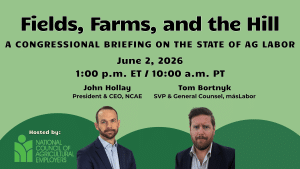
Yesterday, June 2, 2026, the National Council of Agricultural Employers (NCAE) successfully hosted a special educational webinar titled “Fields, Farms, and the Hill: A Congressional Briefing on the State of Ag Labor.” The interactive webinar, co-hosted by Representative Dan Newhouse (WA-04) and Representative Donald G. Davis (NC-01), aimed to arm congressional staffers, agricultural leaders, and stakeholders with vital insights into the H-2A Temporary Agricultural Visa Program.

Led by Tom Bortnyk, Senior Vice President and General Counsel of másLabor, and moderated by NCAE President and CEO John Hollay, the session provided a deep dive into the practical administration of the program. A key focus of the discussion highlighted the common, real-world issues and complex casework challenges currently experienced by farmers and ranchers across the nation who rely on the H-2A program to sustain their operations.

“Effective policy does not evolve in a vacuum,” said John Hollay, NCAE’s President and CEO. “This briefing was a vital opportunity to connect Washington decision-makers and staffers with the actual terrain of American agriculture. By opening this direct line of communication with congressional offices, we are ensuring that future legislative and oversight efforts are grounded in the real-world experiences of agricultural employers.”

In addition to addressing day-to-day farm workforce realities, the briefing tackled the shifting regulatory landscape, including the Department of Labor’s Interim Final Rule and how congressional offices can best handle constituent inquiries.

Access the Webinar Recording

For those who were unable to attend the live event, a recording of the presentation is now available for Congressional staffers, agricultural policy advisors, NCAE membership, and the general public.

  • Watch the Recap: You can view the full webinar recording on YouTube by filling out a brief form here: ncaeonline.org/resources/webinars/.
  • Additional Resources: For more updates and information regarding agricultural labor advocacy, visit the NCAE website at ncaeonline.org.

About NCAE

Founded in 1964, NCAE is the only national association focusing exclusively on agricultural labor issues from the agricultural employer’s viewpoint.

Download Article